SEARCHsearch icon
CLOSE X

Sail away on an ocean odyssey with best-selling illustrator Millie Marotta with this free colouring sheet from her new book!

In Secrets of the Sea, Millie takes to you on a voyage of discovery from the Arctic waters to the balmy Australian coast. Swim with dolphins, narwhals, manatees, and manta ray. Look up to the cries of albatrosses, pelicans and little auks. Grab your pencils and bring to life jellyfish, puffins and polar bears.

The watery world is particularly close to Millie’s heart and she brings her passion to these intricate drawings of shells, pebbles, corals and barnacles. She includes cliffs, reefs, waves and islands to help set the scene. Secrets of the Sea is a must for all colouring fans!

Download your free whale colouring sheet from Secrets of the Sea below. Get creative and don’t forget to add your masterpiece to Millie’s colouring gallery.

secrets of the sea

Millie Marotta’s Secrets of the Sea is available now.

The whale in this blog post is coloured by Lisa Duggan.

The hit Netflix series ‘The Queen’s Gambit’ made many of us reach for our chess sets. Based on a novel with the same name by Walter Tevis, ‘The Queen’s Gambit’ tells the story of chess prodigy Beth Harmon, set in 1950s USA. While the story is fictional, Tevis captured many of the qualities of World Chess Champion Bobby Fischer when he created Beth Harmon. Here, Andrew Soltis, author of Bobby Fischer Rediscovered identifies five similarities between Beth and Bobby.

by Andrew Soltis

1.They were both prodigies

Early in the TV series Beth is described as a prodigy. The only prodigy of that era, the 1950s, was Fischer. Winning game 5 helped him earn the title of international grandmaster at age 15.

2. Speed is their signature

Beth plays her moves remarkably quickly, almost without thinking about them. Fischer made this kind of speed famous in game 29. His opponent exhausted his allotted 150 minutes and lost. Fischer spent only ten minutes to establish a winning position.

3. The effect they have on their opponents

Beth’s opponents run a gamut from the stonefaced world champion Borgov to others who reveal all of their feelings when they lose to her. Fischer forced Soviet grandmaster Yefim Geller to abandon his poker face in game 26. He was an emotional wreck when he resigned.

4. They shared a passion for one particular chess opening

Beth and Benny Watts shared a passion with Bobby – analysing a chess opening called the Najdorf Variation of the Sicilian Defence. Fischer’s unparalleled expertise is shown in game 49.

5. They played multiple opponents simultaneously

We see how quickly Beth is improving when she gives a ‘simultaneous exhibition’ and beat Benny and two other players in separate games. Fischer gave ‘simuls’ spectacular recognition when he gave up tournament chess in 1964 in favour a national exhibition tour. His victory over Hoppe is one of the finest he played on the tour.

bobby fischer rediscovered

Bobby Fischer Rediscovered features analysis of 106 classic Fischer games, including rarely seen ‘lost’ games. With new insights into what made the enigmatic Fischer play – and act – the way he did. Written by International Grandmaster Andrew Soltis who played Fischer and also reported, as a journalist, on the American’s legendary career.

Whether you’re looking for fun activities to do with the kids or are in need of something relaxing to take your mind off the news, we could probably all do with some more colouring in our lives at the moment.

That’s why we’re offering you a bumper selection of free Millie Marotta colouring sheets. Click on the images below to download, then print them out and colour away.

Don’t forget to share the joy of colouring with your loved ones. Share this post with friends and family so they can get colouring too. And fill our digital world with colour by uploading a picture of your finished masterpiece on social media using tag #MillieMarotta and to Millie’s colouring gallery.


The colouring sheets feature illustrations from Millie Marotta’s bestselling books Animal Kingdom, Beautiful Birds and Treetop Treasures, Curious Creatures and Tropical Wonderland (also available as Pocket Colouring editions); and Millie’s new book, Millie Marotta’s Woodland Wild.

Happy colouring!

From eco-friendly bows to Japanese fabric wrapping, Camille Wilkinson shows how to wow friends and family with beautifully wrapped gifts while minimising waste in Gift Wrap Green. Here, Camille shows how to transform an old sweater into fun sustainable gift wrapping.


Transform a favourite sweater that has seen better days into a stylish wrap to make a presentation sleeve for a bottle of wine, or explore one of the variation ideas for more inspiration.


sustainable sweater gift wrapping


What you need

Wine bottle
An old sweater
Scissors
Needle and thread
Ribbon (optional)

  1. Insert the bottle into the sleeve of the sweater to measure where to cut. The cuff should start just below the top of your bottle. Mark the bottle length and remove. Cut the sweater sleeve off so that it is at least 3cm (1¼ in) longer than your bottle. (If you would prefer a nice snug fit, use a child’s jumper, but do make sure the sleeve is long enough.)
  2. Thread the needle with a double thickness of thread and run it through the loose loops at the cut end of the sweater sleeve. Pull gently to gather and tie off.
  3. You can leave the cuff end as it is, fold or roll it, or tie it with a ribbon.


VARIATIONS

To make a gift bag

Cut the sleeve to the desired length, turn it inside out and sew straight across the raw end. Turn through to the right side and finish off with a ribbon to close.

To make a woollen belly band

Neatly cut off the ribbed waist of a child’s jumper and slide it onto your wrapped box. You are looking for a snug fit, and if using an adult sweater, this could be achieved by using the cuff.


gift wrap green

Find more ideas on sustainable gift wrapping in Camille’s book Gift Wrap Green – out now!


Photographs by Michael Wicks.

If the Queen’s Gambit TV-series has got you inspired to play chess, you’re not alone. Online chess playing site chess.com reported a five-fold increase of daily sign-ups to the site following the show’s release and Washington Post wrote that ‘The pandemic sparked an interest in chess. “The Queen’s Gambit” made it explode.’ In this blog post, we explain The Queen’s Gambit chess move, the opening move that inspired the name of the book and TV series.

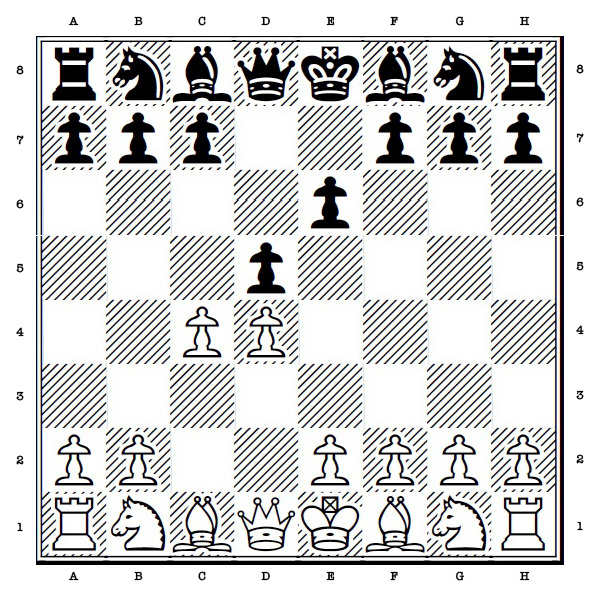
The Queen’s Gambit (1 d4 d5 2 c4) is an opening strategy by White to try and occupy the centre of the board. Or as Sean Marsh puts it in Batsford’s Chess Bible ‘White is offering a temporary pawn sacrifice to try to tempt Black into giving up the centre.’

The move can either be accepted by Black taking the pawn (dxc4) or declined. Marsh explains that ‘after 2 … dxc4 (the Queens Gambit Accepted) White can either rush to occupy the centre with his pawns – 3 e4 – or develop more methodically and occupy a little later.’ He also points out that ‘there is nothing wrong with playing the Black side of the Queen’s Gambit Accepted. But some players feel uncomfortable allowing their opponents an obvious advantage in space. Therefore, the most popular and solid reply is 2 … e6 (The Queen’s Gambit Declined). The next few moves are all about exerting pressure on the centre of the board.’

Below we take a closer look at both the Queen’s Gambit Declined and the Queen’s Gambit Accepted – extracted from the show’s protagonist Beth Harmon’s favourite book Modern Chess Openings.

queen's gambit declined


QUEEN’S GAMBIT DECLINED

1 d4 d5 2 c4 e6

The Queen’s Gambit (1 d4 d5 2 c4) is the keystone to an offensive plan by White on the left hand side of the board. The character of the game differs greatly from that of king pawn openings, which often quickly result in open clashes. The Queen’s Gambit takes the game to a strategic battle where the tactical clashes are delayed until the middlegame. The offer of a pawn with 2 c4 is what gives the opening its edge, as the c-pawn attacks Black’s central strongpoint. However the “gambit” in the opening’s name is rather a misnomer as Black cannot really hold on to the pawn. There is also a stark difference from the King’s Gambit in that the white king’s safety is not compromised by the pawn advances on the left hand side of the board.

The Queen’s Gambit is one of the oldest openings, first mentioned in the Göttingen manuscript of 1490, then later the subject of analyses by Salvio and Greco in the early seventeenth century. Theorists in the nineteenth century discussed the best way to meet the gambit. The majority of chess writers, starting with Jaenisch (1843), seemed to be of the opinion that holding the centre with 2…e6 was the best defence. After this move there are many divergences, some depending on what White does and others on Black’s choices.

Strategically, White’s plan when playing 2 c4 is to attack the centre and remove Black’s d-pawn from its central position so that White is free to advance the e-pawn to e4. By playing 2…e6 Black frustrates his opponent’s plan but imprisons the light-squared bishop. Black will often try to imitate his opponent by attacking White’s d-pawn with a timely …c5. In the course of this struggle one side or the other will often accept structural weaknesses in return for dynamic strengths. Isolated and hanging pawns abound for both sides in this group of openings.

queen's gambit accepted

QUEEN’S GAMBIT ACCEPTED

1 d4 d5 2 c4 dxc4

The most straightforward defence to a gambit is usually to accept the pawn and make the opponent prove the worth of the sacrifice. This, however, is not the plan behind accepting the Queen’s Gambit. Attempting to hold on to the pawn usually leads to trouble. Yet if Black uses the time White takes to recapture the pawn for development, then he can count on a safe journey through the opening stage. As opposed to the King’s Gambit Accepted with its many sacrifices, the Queen’s Gambit Accepted is a safe and solid choice, albeit somewhat stodgy.

The opening dates back to Damiano in 1512. In the early centuries Black would try to hold on to the booty, which gave the opening a bad name. It took until the twentieth century for the modern concept behind 2…dxc4 to come to the fore. Black plays for free development and to saddle White with an isolated d-pawn after …c5 and …cxd4. Black’s “problem child” of the Queen’s Gambit Declined – the light squared bishop – always finds an active post on g4 or b7 in the Queen’s Gambit Accepted.

The disadvantage of 2…dxc4 is that Black gives up the centre. With nothing on d5 blocking the lines, White obtains active pieces and freedom of action. When the isolated pawn arises on d4, White often has good attacking chances as this pawn may threaten to advance, opening lines of attack. Yet this advance can also lead to wholesale exchanges, producing sterile equality. For particularly this reason, the Queen’s Gambit Accepted is considered a pretty safe opening.

modern chess openings as seen in the queen's gambit

Extracted from Batsford’s Modern Chess Openings by Nick de Firmian, available in paperback and as an ebook. 

Batsford’s Chess Bible by Sean Marsh is available in hardback and as an ebook.

Explore our chess book range here.

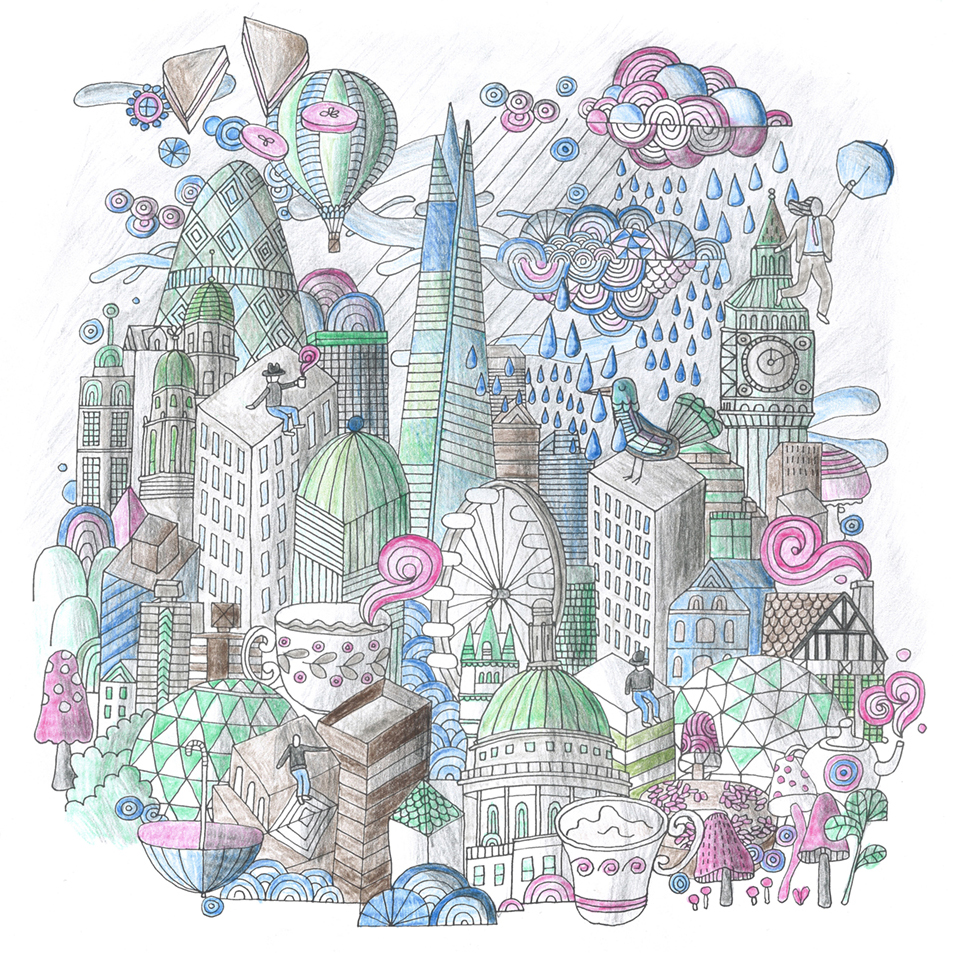
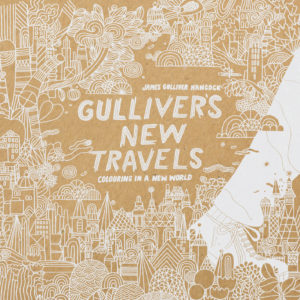
It’s a rainy autumn day in London today. One of those days that seem to be made for WFH. But, if you miss the rainy streets of London – jumping out of the way of puddles and struggling with a broken umbrella. Or indeed, if you’re caught up in the weather and in need of a nice break. Try this rainy day London colouring sheet freebie, from Gulliver’s New Travels by James Gulliver Hancock.

rainy day colouring london

Gulliver’s New Travels is a modern take on the classic Gulliver’s Travels in the form of a colouring book. Illustrator James Gulliver Hancock brings together his obsessions with re-imagining the world and travelling with his attention to scale and detail. The result is a creative colouring book inspired by Swift’s 18th-century classic, featuring different worlds and playing with scale as in the lands of teeny Lilliput and giant Brobdingnag. There is a whole imaginary world to colour in. Taking in places from around the world, from all landscapes, and even future worlds and those in galaxies far away, the illustrations are playful and fanciful but always wonderful to look at.

So grab your pencils, put the kettle on and enjoy some rainy day colouring.

gulliver's new travels

Find more fantastical illustrations to colour in Gulliver’s New Travels by James Gulliver Hancock, out now.


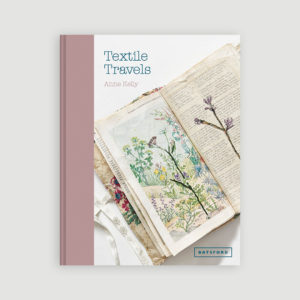
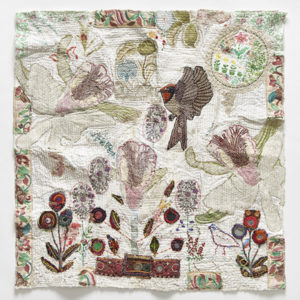
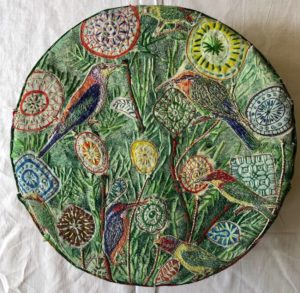
Travel has always featured heavily in textile art, from artists’ ‘travelling sketchbooks’ to large-scale installations mapping coastal erosion or the effects of climate change. In Textile Travels, renowned textile artist Anne Kelly shows how to capture your travels, past and present, in stitch, with practical techniques sitting alongside inspiring images. Here she shares some of her favourite pieces from the book and the inspiration behind them.


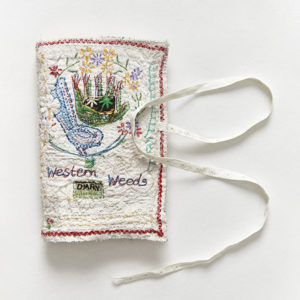
Western Weed Sketchbook

Mixed-media on paper

I made this sketchbook for a teaching tour to the West Country in the summer of 2019. It was meant to be a prompt for me to make some work after my teaching sessions were over. It became an enjoyable ritual drawing and stitching at the end of each day. I was delighted that a page from the book was used for the cover of Textile Travels.


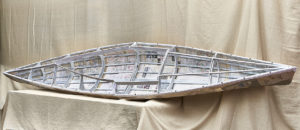
Unfinished Journey Boat

Mixed-media textile, paper and wooden boat

This piece will form the centrepiece for my solo exhibition at Ruthin Craft Centre in 2021. It was made using a wooden canoe skeleton which was repurposed and covered with a mixture of paper and textile, taken from a collection of unfinished embroidery patterns. The piece is in a chapter about space and exploration.


Maudie’s House

Mixed-media textile

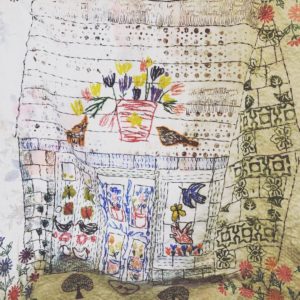
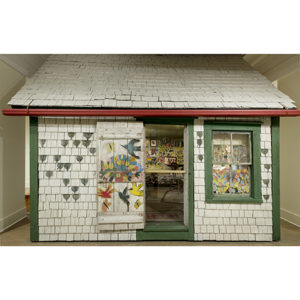
This was a piece inspired by Maud’s House from the Art Gallery of Nova Scotia in Canada. It was first exhibited at the Compton Verney Textile Fair in 2018, and then toured with the Embroiderers Guild Home exhibition through 2019. It was inspired by travel and then went on travels of its own. The second image shows the original inspiration in situ.


Home Fires Dress and Family Portraits

Mixed-media textiles

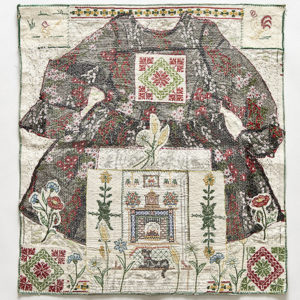
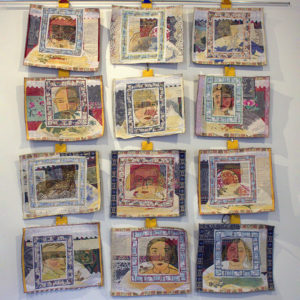
The Articles of Ancestry page in the book shows two pieces from my solo exhibition at Timeless Textiles gallery in Australia in 2019. It is the only commercial textiles gallery in Australia and shows a variety of local and international artists. It was a wonderful venue and exhibition and this page reminds me of happy times travelling and teaching in Australia and New Zealand.’


Maharini Gardens and Maharini Gardens Bag

Mixed-media textile/mixed-media textile on calico

These two pages in the book celebrate the amazing heritage and traditions of textiles in India. I was fortunate to make three trips to India to see makers and craftspeople in different areas of the country. I learnt so much about stitching, block printing and colour on cloth. I tried to capture the colours, textures and imagery in the pieces illustrated here.


Textile Travels by Anne Kelly is out now. Anne will be signing copies of the book at Pincusion Pantiles in Tunbridge Wells, Saturday 3 October 2–4pm.

Photographs by Rachel Whiting.

Today is National Poetry Day, a day set up by the Forward Arts Foundation to encourage all to enjoy, discover and share poetry. We’re celebrating the day by sharing poems from our books.

A Nature Poem for Every Night of the Year is a calming collection of nature poems to help you relax and unwind at the end of every day. To mark National Poetry Day, editor Jane McMorland Hunter has selected a couple of her favourite poems from the book.

There is a Solemn Wind To-Night

by Katherine Mansfield (1888–1923)

There is a solemn wind to-night⁠
That sings of solemn rain;⁠
The trees that have been quiet so long⁠
Flutter and start again.⁠

The slender trees, the heavy trees,⁠
The fruit trees laden and proud,⁠
Lift up their branches to the wind⁠
That cries to them so loud.⁠

The little bushes and the plants⁠
Bow to the solemn sound,⁠
And every tiniest blade of grass⁠
Shakes on the quiet ground.⁠

This autumnal poem by Katherine Mansfield is the poem that Jane selected for 1st October.

Night

by William Blake (1757–1827)

The sun descending in the west,
The evening star does shine;
The birds are silent in their nest.
And I must seek for mine.
The moon, like a flower
In heaven’s high bower,
With silent delight
Sits and smiles on the night.

Farewell, green fields and happy groves,
Where flocks have took delight:
Where lambs have nibbled, silent moves
The feet of angels bright;
Unseen they pour blessing,
And joy without ceasing,
On each bud and blossom,
And each sleeping bosom.

Night by William Blake features in Songs of Innocence, Verses 1 and 2, originally published in 1789.


Now over to something more contemporary. Our Isles by Angus D. Birditt and Lilly Hedley was published earlier this year and is a celebration of rural lifestyle.

The Shepherd⁠

Poem by Angus D. Birditt, illustration by Lilly Hedley

From head to source of upland flow⁠
Run the hills with morning dew;⁠
Over tops of heather and scented larch⁠
To the heights of life we seldom march.⁠

Come scale the wild and weathered rock⁠
Where life is quiet and eagles soar,⁠
For amongst these lands of valleys deep⁠
You’ll find the kind that herds in sheep.⁠

Amid the chorus of dawning calls⁠
These folk arise with canine friends,⁠
Ascending the hill in twos or threes⁠
To scan the land, all things to see.⁠

With knowing calls his dogs go free⁠
To rush and reach the peaks beyond;⁠
How quick they’re off to round up the flock,⁠
Past swathes of gorse and lady’s smock.⁠

Their bodies dart the land in black,⁠
Where soon they’ll find all strays of ewe;⁠
Swift to move on the knock of crook⁠
They swing to back and crouch to look.⁠

Our Isles is a project that explores artistry and rural life in the British Isles through poetry, printmaking and photography. The Our Isles Exhibition is currently showing at the Oriel Davies Gallery. Book your FREE ticket here.


Explore A Nature Poem for Every Night of the Year, Our Isles and our range of poetry books.


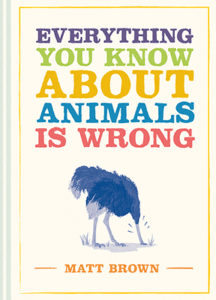
In Everything You Know About Animals is Wrong, Matt Brown debunks common myths from the world of animals. Dogs are of course human’s best friend, but even though we know them well, they’re still not exempt from a myth or two. Today is International Dog Day, a day to celebrate our furry besties and a great opportunity to try and understand them a bit better. Read on as Matt sets the record straight on dogs’ vision.

by Matt Brown

Were you to ‘quantum leap’ into the body of a dog, you would immediately notice the change in your senses. A heightened awareness of smell and sound would transform your local environment. At the same time, your eyesight would wane. Dogs can see well, but not as sharply as humans. Until recently, it was believed that our four-legged friends lacked any colour vision, but this has now been rejected.

A dog watching The Wizard of Oz – perhaps a descendant of Toto himself – would notice the change in the visuals when Dorothy steps out into the land of Oz. While the human viewer sees a transition from black and white to full Technicolor, the mutt would see a Munchkin village of limited hues. Dorothy’s blue dress and the yellow brick road would still be present and correct, but the ruby slippers and Wicked Witch’s green face would appear a drab grey colour.

Or so is the best guess. It is not, of course, possible to experience the perceptions of other animals. Yet. Anatomical study of the canine eye does suggest, however, that the dog has the visual kit to detect a limited range of colours. Dog eyes have two types of colour-sensing cone, while humans have three. They can probably make out blues and yellows but not other hues. Behavioural studies lead to the same conclusion. Our four-legged friends may not care much for the rainbow, but they may appreciate a clear, blue sky.

everything you know about animals is wrong

Extracted from Everything You Know About Animals is Wrong by Matt Brown. Illustrations by Sara Mulvanny.

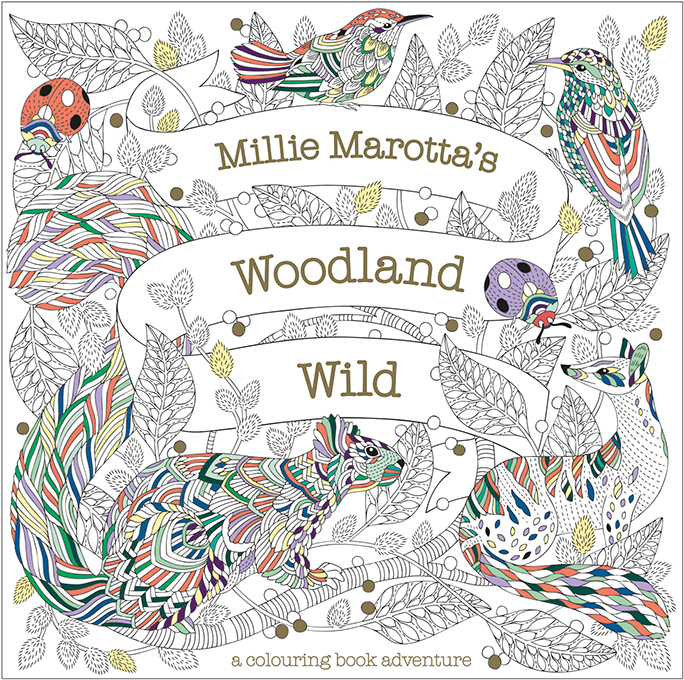
We are super excited to publish the new book by bestselling colouring book illustrator Millie Marotta this September. In Woodland Wild, you can colour in wildlife from across the world’s forests. What’s more, Millie has released an early illustration from the book as a free colouring download so that you can get colouring straight away!

Millie Marotta’s Woodland Wild features over 90 illustrations of woodland wildlife from around the globe. Millie invites you to add your own palette to a huge range of species who make the woods their home. From fireflies to fallow deer, wild boar to dainty ladybird, and magnolia trees to forest wolves.

Millie, who studied wildlife illustration at college, has meticulously researched woodland habitats and has brought them to life in her signature style. She comments:

I’m thrilled to be exploring the world’s incredible woodlands – home to a hugely rich and diverse variety of flora and fauna – for my new colouring book, which I can’t wait to share with the worldwide colouring community. I hope fans will be delighted by the illustrations and may even discover a species they didn’t before know about as they bring each page alive with colour, in a celebration of our precious natural world.

millie marotta's woodland wild

Millie Marotta’s Woodland Wild is publishing on 17th September and is available to pre-order now from online retailers including A Great Read, Waterstones and Blackwells. You can also enquire with your local bookseller about pre-ordering the book.

But you don’t have to wait until then to colour in the Woodland Wild! Millie is treating us to a taster illustration as a free colouring download, featuring one of our favourite woodland dwellers – the hedgehog.

Download this cute little fella below and share your coloured-in masterpiece on social media using hashtag #MillieMarotta.

Happy colouring!

In Raw Drawing, visual designer Alessandro Bonaccorsi shows you how to draw in a truly spontaneous and carefree way. Leave your stresses and inhibitions behind and try out these simple Raw Drawing exercises to jump-start your imagination.

From doodles to dangerous monsters, Raw Drawing will enable you to reveal your real imagination, get closer to the heart of things and learn to appreciate the beauty of the spontaneous. It’s a non-judgemental technique to help you visualise your thoughts, express your emotions, develop ideas and disappear into your own drawn world.

Since launching the Raw Drawing initiative, Alessandro Bonaccorsi has given dozens of courses, helping people expand their creativity. In Raw Drawing, he brings together all of his core teachings, making the power and creativity of Raw Drawing accessible to everyone.

Alessandro describes Raw Drawing as follows:

‘We need to find the way back to when we were ancient, to when we were children, to make our way back down a path that has fallen into disrepair, overgrown with brambles and weeds, a path walked for millennia before being forgotten: this is the path of Raw Drawing. We need to regain our confidence, feel grateful again for the lines we make, enjoy ourselves and discover the great revelatory power of drawing. What is important on the path of Raw Drawing is the process of drawing, or rather the simple pleasure derived from the activity of drawing; the movement of your hand as it follows what it innately knows and does. The Raw Drawing Path will not turn you into the next Leonardo Da Vinci.

You don’t need will power, nor the dexterity of a tightrope walker. All you will need to do is let yourself go and aim for ‘nothing’ through the dogged pursuit of wellbeing, and the satisfaction derived from ‘non-doing’, where the end result is not what’s important.

To achieve this, you would do well to leave your possessions behind – like St Francis before his hermitage and sainthood – and strip yourself of all you know about drawing, of what you have been told about drawing and of what you have learned and experienced about drawing. ‘

Free Raw Drawing taster exercises

Try out Raw Drawing for yourself with these exercises. Download and print at home, or simply use a piece of scrap paper for your doodles.

Raw Drawing by Alessandro Bonaccorsi is out now.

Never mind the rights and wrongs of Brexit. Pretty much everything we know about our country is steeped in error and misconception. In his new book Everything You Know About England is Wrong, Matt Brown debunks some of England’s most tenacious myths, from the near-universal confusion over how the country fits into Britain and the UK, to why Scottish banknotes are not legal tender in England, to the idea that we all love warm beer, afternoon tea and a full English breakfast. Here, he shares four of the more historical nitpicks.

By Matt Brown

Henry VIII

Henry VIII was not married six times

Go up to any person in the street and ask them to name one fact from English history. About 50% of people will say that Henry VIII had six wives. (The other half will withdraw eye contact and speed off.) It’s the ultimate everyone-knows-it fact. And it’s wrong. On a technicality.

The portly monarch said his vows on six occasions, this much is true. His queens, as trivia fans can list, were Catherine of Aragon, Anne Boleyn, Jane Seymour, Anne of Cleves, Catherine Howard and Catherine Parr. But here’s the thing… three of those marriages officially did not take place.

Divorced, beheaded, died; divorced, beheaded, survived. So goes a popular mnemonic to remember the fates of Henry’s wives. That word ‘divorced’ is not quite accurate, though. Henry’s marriages to Aragon, Boleyn and Cleves were annulled, which is to say they were retrospectively declared invalid, as though the ceremony had never taken place. Legally, then, the corpulent monarch had only three wives.

Henry’s multi-matrimonial conduct came entirely in his later years. His first marriage to Catherine of Aragon was surprisingly long-lived. The pair stuck together for 24 years. The mean length of time for a marriage that ends in divorce today is 11.7 years, so Henry was twice as steadfast as the modern standard.
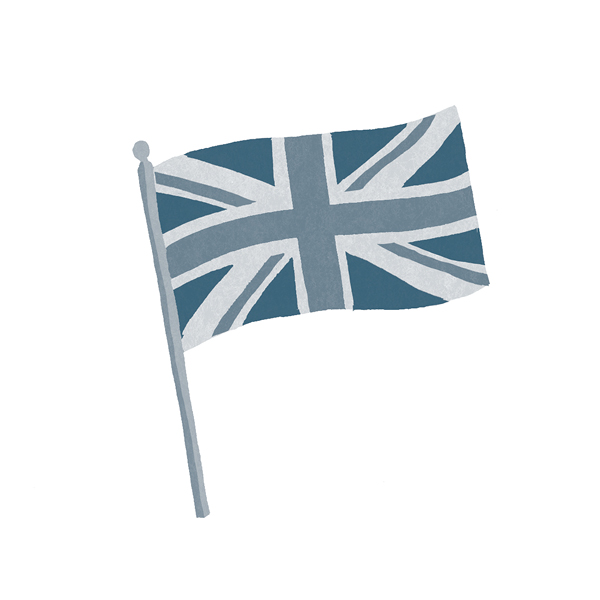
Union Jack

It’s not wrong to call the Union Flag a Union Jack when not at sea

This, this, THIS, dear reader, is the ultimate plaything of the pedant. Nothing is more likely to wake a nitpicker from his slumbers (and it is usually a he) than to point at the national flag fluttering over a town hall and call it a Union Jack. ‘I think you’ll find,’ you will at once be advised, ‘that it’s only a Union Jack when flown at sea, on a ship. When raised on a building, it should be called the Union Flag’.

Well, I’ve looked, and I don’t find that, thank you. First off, the Union Jack’s career as Britain’s national flag is merely a custom. No law, Act of Parliament or Royal Decree ever established its status or its name. We may call it the Union Jack, or the Union Flag, or Winston Churchill’s Multicolour Hanky, or anything we like, and we are not at odds with officialdom.

Next, the Flag Institute – the UK’s national flag charity – notes that the Jack versus Flag distinction is a recent one. Before the mid-20th century, the flag was near-universally referred to as the Union Jack, whether on land or boat.

It is a useless distinction, in any case. Why should a flag change its name just because it has gamely ventured out onto the water? The whole point of a national flag is its universality. It should be recognised and understood by everyone. Why muddy the waters by having two names? Plus, ‘the Union Flag’ stinks as a name. It’s bland and generic and could apply to any group of united territories. Union Jack is unique and internationally recognised as a hallmark of Britain.

That brings us on to the most serious error concerning the Union Jack, and that is to fly it upside-down. I say ‘serious’, but there is only one consequence in doing so: you will anger another cohort of pedants. People get greatly exercised by this kind of thing. ‘Sir – I was disgusted to notice that the Union Jack flying over the Town Hall in celebration of St. George’s Day was being flown upside down,’ wrote one livid reader of the Banbury Guardian in 1950. Many other examples can be found in the newspaper archives; it is a pet subject of the kind of people who like to write letters to editors. Incidentally, every example I can find from the mid-20th century (and there are many) refers to the Union Jack and not the Union Flag, again showing how that piece of pedantry is very recent.

For the record, a correctly flown Union Jack should have a thick white band touching the top of the flag on the side attached to the flagpole. Tradition has it that an upside-down Union Jack is a symbol of distress. If that ever were the case, it is no longer a sensible way to seek help. Far better to wave your arms about and look distressed than to carefully orient and raise a flipped Jack in the hope of attracting a passing flag geek.

City of London

An English city must have a cathedral

What constitutes a city? In England, there is only really one way to tell. A city is a place that the monarch, or long tradition, has declared a city. No other criterion – the presence of a cathedral, university or decent coffee shop, say – is relevant.

We might suppose that a city is simply a large town. Birmingham and Manchester are clearly cities; Pontefract and Mablethorpe are indubitably towns. It’s not hard, though, to find munchkin cities that don’t meet expectations. The City of London is England’s smallest. With a resident population of 8,000 people and well-known dimensions of a square mile (it’s actually slightly larger), it would be small even for a town. Compare this with some of England’s largest towns – Reading (233,000), Dudley (195,000) and Northampton (189,000) – and we see that population size is no certain indicator of city status. More people live in Croydon (just one of 33 local authorities in London) than in the 11 smallest English cities combined. Croydon has never been granted city status, despite asking six times and containing several very good coffee shops.

Neither population nor size alone is good enough to establish somewhere as a city. So what about a cathedral? Received wisdom holds that the presence of a big church is a golden ticket to citydom. That was once true, but the rule no longer applies. Fifteen English cities have no Anglican cathedral, including Cambridge, Leeds, Nottingham, Sunderland and Westminster (the Abbey does not have cathedral status, while Westminster Cathedral is Catholic). Conversely, five English towns possess a cathedral but are not considered cities. These are Blackburn, Bury St Edmunds, Guildford, Rochester and Southwell.

England currently contains 51 cities, and the wider UK supports 61. The most recent is Chelmsford, granted city status in 2012 to mark the Queen’s Diamond Jubilee. Similarly, Preston got the nod in 2002 as part of the Golden Jubilee. If the Queen is still with us in 2022, perhaps Croydon will finally get its wish at the seventh time of asking.


Charles I was the last monarch to be put to death

The execution of King Charles in 1649 was a momentous event in English history. For the first time in 700 years, England had no monarch. This was the only period in which the country has functioned as a republic. The interregnum was short-lived. Just 11 years separated Charles’s execution and the Restoration that saw his son, Charles II, reclaim the throne. England (or Britain) never dabbled with republicanism again. We did, however, kill another king.

George V is today noted for three achievements. He was Queen Elizabeth II’s granddad. He bestowed the word ‘Regis’ on Bognor Regis after convalescing in the town. And he gave the country almost 500 playing fields by way of a memorial. He should also be remembered as the last British monarch to be murdered.

In 1928 the king fell ill with septicaemia and lung problems whose effects stayed with him for his remaining eight years. The following year, George spent 13 weeks in Bognor under the slightly dubious but widely believed advice that seaside air is good for the constitution.

Finally, in January 1936, he could continue no longer and retired to his bedroom at Sandringham. After several days falling in and out of consciousness he passed away on 20 January. George was not permitted a natural end. The king’s physician Lord Dawson of Penn accelerated the inevitable by administering a lethal dose of morphine and cocaine. The ailing monarch was euthanized. These facts only emerged in 1986 with the publication of Dawson’s private notes. The physician had taken the decision to end the king’s suffering. Astonishingly, and by his own admission, Dawson gave the fatal injection before midnight so the news could break in the morning papers, rather than the ‘inappropriate’ evening news. Assisted dying was illegal in 1936. Dawson had effectively committed murder and, indeed, regicide. The establishment reacted by advancing him to Viscount a few months later. The king’s final words were either ‘God damn you’ or ‘Bugger Bognor’, depending which story you believe.
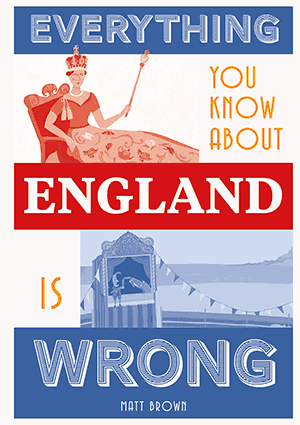
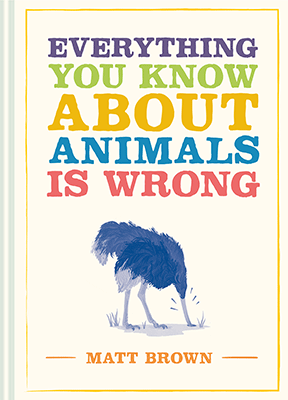


Matt Brown is author of eight Everything You Know… books, including Everything You Know About England is Wrong, and the most recent Everything You Know About Animals is Wrong, published by Batsford.

Illustrations by Sara Mulvanny.

0
    0
    Your Basket
    Your basket is emptyReturn to Shop